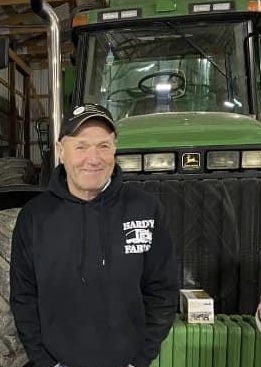
Pat Hardy (Hardy)
Herbert Boyer and Stanley Cohen
Catalysts of GMO Technology
"I am always concerned that a new weed or bug will come along that will become resistant. Also some countries might not allow imports of our grain."
~Pat Hardy, Missouri Farmer
Pat Hardy (Hardy)
"I have been farming since I graduated from high school 50 years ago."
"I use GMO corn and soybean seed in my fields."
"Before GMO corn and soybean seed came along, we would work our fields several different times to kill as many weeds as possible before planting crops. Once the crop was up and still very small, we would use a rotary hoe at a high rate of speed to kill as many weeds as possible."
"After the crop got a little taller we would use a cultivator to clean the weeds out of the crop. Sometimes if there were weeds still in the crop, we would walk up and down the rows and pull any weeds left by hand."
"When we were using non GMO soybean seed (usually a public variety), we got our seed right out of our own bin. We then put 100 bean seeds in a damp cloth and counted how many of them sprouted to know what the germination would be. We would load a wagon full of beans and take them to the local elevator and have them cleaned."
"GMO seeds allowed for easier control of weeds and an increase in yields. We do a lot of no-till farming and are able to farm more acres with less fuel because of the control of weeds we get using GMO seeds."
"GMO seed can be modified to be drought-tolerant, disease-resistant, modified for hill ground and bottom ground which increases yields."
"I am always concerned that a new weed or bug will come along that will become resistant. Also some countries might not allow imports of our grain. For example, Mexico is talking about not taking our GMO corn. Right now we have a weed called water hemp that is resistant to glyphosate or Roundup chemicals. We are using Enlist chemical now and it is getting the job done. There is also a concern for humans to become resistant to some antibiotics because of GMO food consumption."