"There is serious concern that some of these artificial recombinant DNA molecules could prove biologically hazardous."
(Berg et al. Science, July 1974)
Herbert Boyer and Stanley Cohen
Catalysts of GMO Technology
("DNA Double Helix," n.d.)
"Genetic recombination is nothing new. What we are doing in test tubes is just an application of what nature does in living cells all the time."
~ Dr. Stanley Cohen, Geneticist and Biochemist (Anderson, Santa Cruz Sentinel, 14 June 1978)
In 1974 after Cohen and Boyer's discovery, a group of scientists published an article about the possible issues with recombinant DNA research, including recommendations to address these issues. Later in 1976, the National Institutes of Health issued the first federal guidelines for recombinant DNA research.
"There is serious concern that some of these artificial recombinant DNA molecules could prove biologically hazardous."
(Berg et al. Science, July 1974)
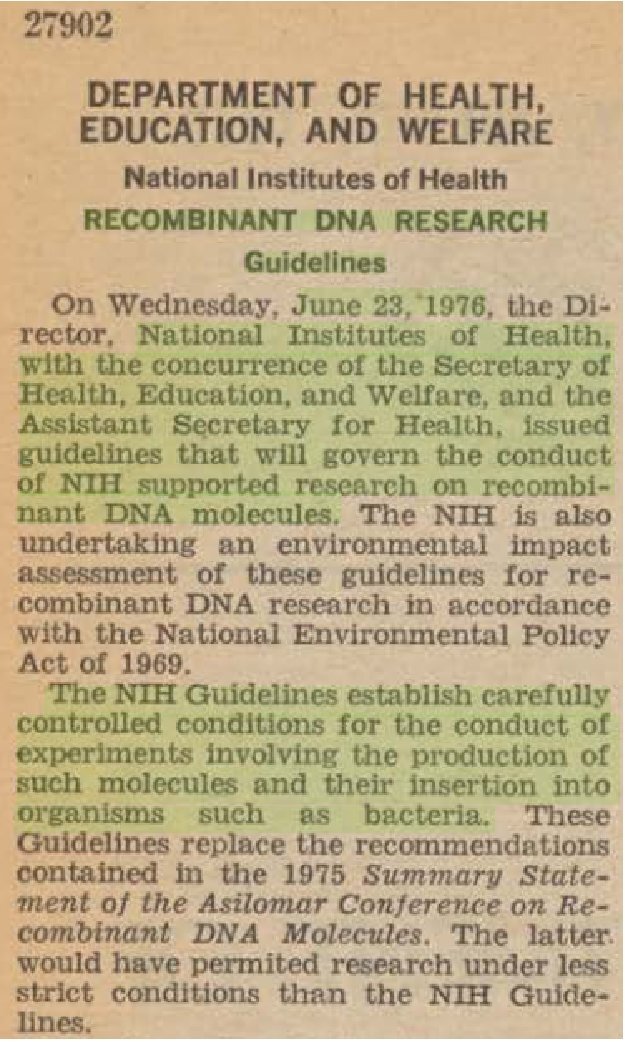
"National Institutes of Health. . . issued guidelines that will govern the conduct of NIH supported research on recombinant DNA molecules."
(Federal Register, National Institutes of Health, Recombinant DNA Research, 7 July 1976)
"From hindsight, most reputable research scientists feel they overreacted to the possible hazards of the problem."
(Anderson, Santa Cruz Sentinel, 1978)
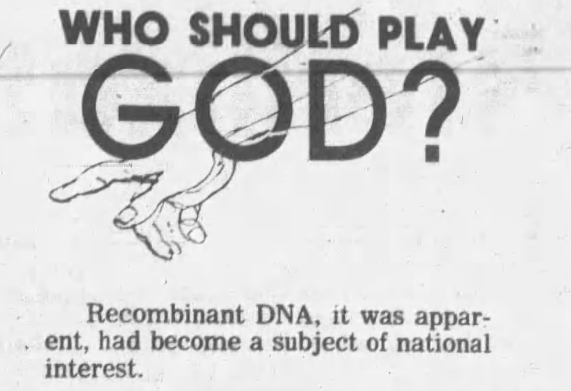
"Who Should Play God?"
(Howard, Oakland Tribune, 28 Mar. 1978)
"Recombinant DNA chimeras hide within their outward beauty a deep and dark danger."
(Howard, Oakland Tribune, 28 Mar. 1978)
"I felt that this question of potential biohazards should be addressed. I never thought it was a significant problem. I thought it was overblown by the scientists, and it was picked up on by the media, and the whole thing got out of control and was very unfortunate. I don't think it served any real purpose."
~ Dr. Herbert Boyer, Biochemist (Boyer, The UCSF Oral History Program, 1994)
Today, some people have religious and philosophical concerns about GMOs. Many people, organizations, and countries around the world are also worried about possible health and environmental threats caused by GMOs. Several countries ban the import and/or cultivation of GMO crops. Labeling of GMO products is also a concern in the U.S. and other countries. In January 2022, the U.S. Department of Agriculture started mandating the labeling of foods that are genetically modified or have GMO ingredients (Peikes).
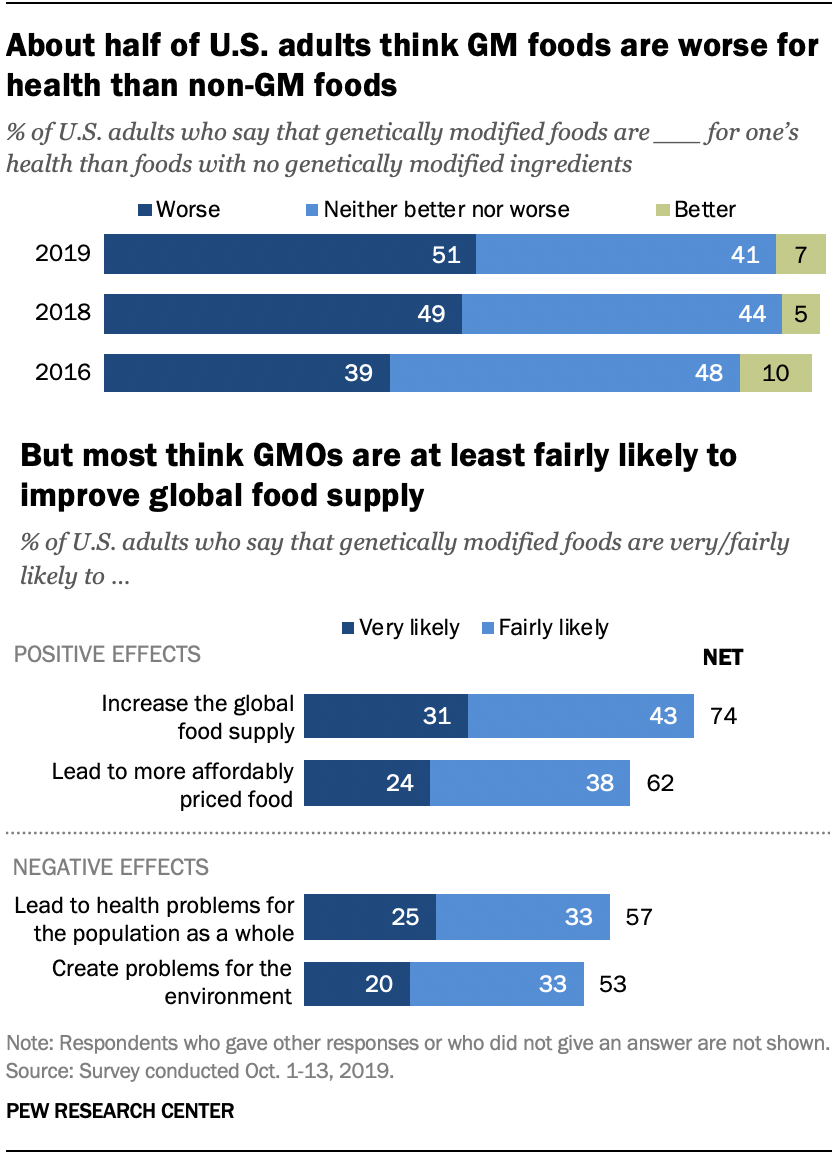
"About half of U.S. adults think that GM foods are worse for health than non-GM foods."
(Funk, Pew Research Center, 18 Mar. 2020)
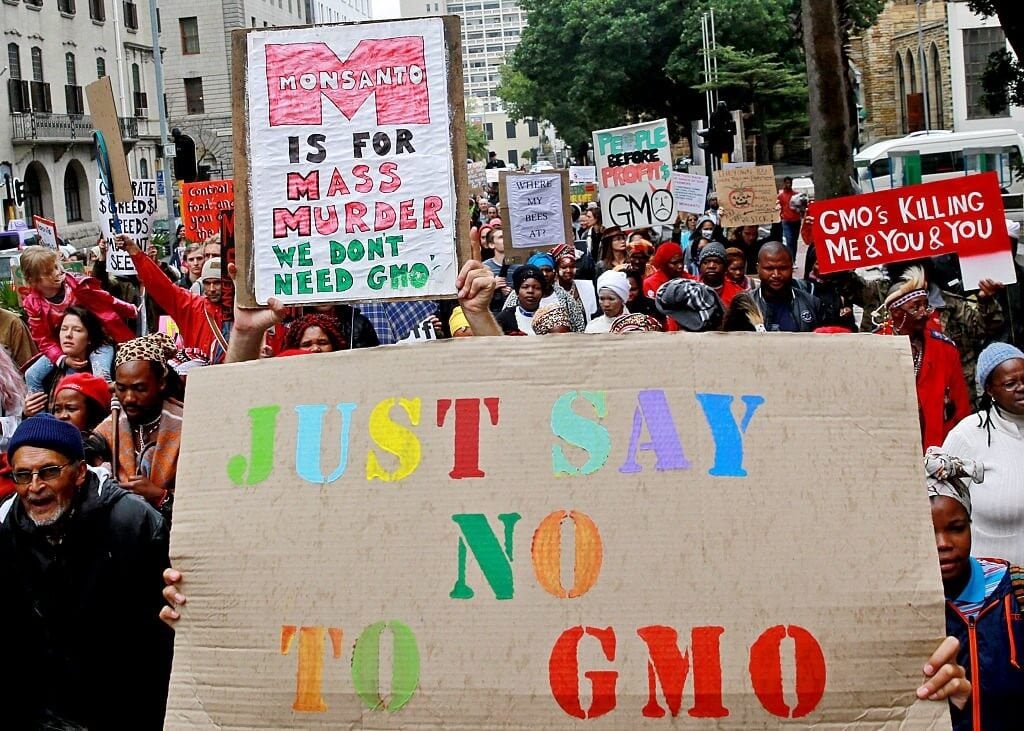
GMO Protests
(Digital, Genetic Literacy Project, 7 Feb. 2017)
"Major biotech companies want to release new gene-edited GMOs into our food supply and environment."
(“7 Reasons,” Youtube, 20 Oct. 2022)
"Some countries might not allow imports of our grain. For example, Mexico is talking about not taking our GMO corn."
~ Pat Hardy, Missouri Farmer (Hardy, Email Interview, 12 Apr. 2024)

(Peterson, Wall Street Journal, 1 Dec. 2022)
However, the U.S. Food and Drug Administration (FDA) states that GMO products are just as safe as non-GMO products. Before any GMO products are released, they are tested by several federal agencies.
"GMOs are as safe and healthful to eat as their non-GMO counterparts."
(“GMOs and Food Safety," Youtube, 4 Aug. 2022)
"GMOs are safe for humans, animals, and our environment."
(“GMOs and Food Safety," Youtube, 4 Aug. 2022)
"GMO technologies are powerful and have helped us to better understand our world and to solve important challenges, and they will continue to do so. There are guard rails that help to protect people and the environment to ensure that GMO technologies are being used in ways that are responsible and safe."
~ Dr. Steven Whitham, Iowa State University Professor and Plant Biologist (Whitham, Email Interview, 4 May 2024)
No matter one's opinion on GMOs, Boyer and Cohen's discovery has changed the world forever; it will go down as one of the most significant turning points in the history of the agricultural and medical industries.